A3 Agentic Architecture
Build agentic UX and business workflows that are trustworthy, governable, and reliable.
The Agentic App Architecture (A3) combines the best aspects of deterministic programming and dynamic generative AI.
Why A3 Exists
Agentic AI is powerful. Without structure, it becomes unpredictable.
A3 is a lightweight, precise foundation. It provides:
- Clear agent responsibilities
- Controlled routing between agents
- Structured, validated outputs
- Persistent session state
- Pluggable storage
- Enterprise-ready architecture
Agentic solutions that serious businesses can run in production, not dev experiments.
Innovation With Guardrails
Generative AI flexibility with deterministic predictability: clear boundaries, inspectable state, structured outputs.
Designed for High-Trust Environments
For sectors where reliability matters: tech enterprises, research and biotech, startups, healthcare, and fintech. Confidence, not just capability.
How It Fits
Open source. Standalone or with the GenUI stack. For teams, enterprises, and partners.
Built the GenUI Way
Built for scale. Same principles, every engagement.
Start Thoughtfully
Explore the framework. Review the architecture. Or talk to us about your use case.
Session-first, not workflow-first
Conversation is the primitive. Session data loads and persists; agents hand off within the same turn. You get dynamic multi-agent routing without building a graph. Unlike personal-assistant tools built around a single-user trust boundary, A3 targets product-grade, multi-tenant deployments where each user gets isolated session state.
Schema-validated, not freeform
Every agent declares a structured output schema. A3 merges it with base fields and validates at runtime. Downstream systems get typed JSON, no parsing guesswork. That's critical for regulated workflows and commerce where billing, orders, and records need deterministic inputs.
Your stack, your infra
A3 is a library you embed, not a platform you adopt. Self-host by design. Works with cloud APIs and local models: Bedrock, OpenAI, Claude, and local runners like Ollama. Deploy on your own infra and lean on your existing audit tooling, no third-party observability required.
What it's for
Regulated workflows
If you need compliance-safe agent orchestration, Zapier is out (no BAA). n8n Cloud doesn't offer a HIPAA BAA. OpenClaw has faced well-documented security and misuse issues. A3 runs inside your compliant AWS boundary with session state, schema validation, and audit-friendly patterns.
Product-embedded chat
Split intent by domain: returns, order status, loyalty, fraud, without maintaining a giant flowchart. Shared session state and typed outputs let you treat the agent layer as a reliable interface to your backend.
Bounded workflows, not do-everything assistants
A3 is not a general-purpose assistant. It handles bounded workflows with a clear start and end. Within that scope, agentic reasoning handles fluid, unpredictable situations. TypeScript-native, minimal setup. No bloat, no Docker image, no SOUL files to be prompt injected.
How A3 compares
A3 sits in the "code-first, session-centric agent orchestration" lane. Other tools are strong in autonomy, graph design, or workflow automation, but solve adjacent problems.
| If you're considering… | A3 fits when… |
|---|---|
| OpenClaw | You need deterministic, production-grade agent orchestration with explicit state, typed outputs, and predictable routing. OpenClaw is goal-driven and autonomous; A3 is code-defined and reliability-first. |
| LangGraph | You want dynamic runtime agent routing in TypeScript without predefining graphs. Choose LangGraph when you need explicit graph modeling, durable checkpoints, and built-in pause/resume primitives. |
| Zapier / Make / n8n | You need conversational multi-agent coordination with shared session state and schema validation. These tools excel at trigger → action automation and SaaS integrations. Use them for workflow glue; use A3 for the agent layer. |
A3's sweet spot: session-centric multi-agent orchestration, schema-validated outputs, dynamic routing, and deployment on your own infrastructure in a lightweight TypeScript-native package.
Use cases
- Patient and staff assistants: longitudinal conversations across triage, scheduling, insurance, and billing agents with shared state and typed handoffs to EMR or revenue systems.
- Commerce and support: a single chat surface coordinating specialized agents (orders, returns, loyalty, fraud) with controlled routing and model fallback for reliability.
- Regulated workflows: deploy on HIPAA-eligible infrastructure such as AWS Bedrock; keep sensitive data within your boundary while maintaining auditability.
Case Study
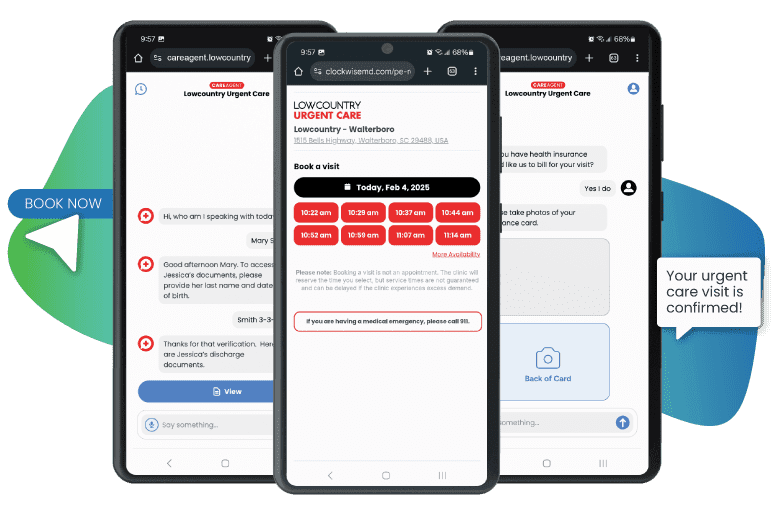
Experity accelerates urgent care with Care Agent
Care Agent is an agentic user experience that automates patient discharge, lab delivery, and document access across more than 2,000 urgent care clinics — serving ~1M patients and 3.5M+ sessions while staying HIPAA-compliant.
2,000+
Clinics deployed
68%
Discharge automated
3.5M+
Sessions completed
~1M
Patients served
“Care Agent doesn't just communicate; it lets you build lasting relationships. Staff is doing the work that improves experience and throughput rather than repeating administrative tasks.”
Ready to build?
Want to go faster with A3? Talk with GenUI.
Open source. Self-hosted. TypeScript-native. AWS-ready.